
Last Updated: November 1, 2026
Quick Summary
Garage door spring installation safety means treating every spring as a loaded weapon until tension is fully released. Replacing a spring or working on any spring under tension is professional-only work, while adding a safety cable to an intact, at-rest extension spring is limited maintenance a careful homeowner can do.
- A safety cable does not stop an extension spring from breaking; it only contains the broken pieces.
- Install one containment cable through every extension spring and never share a cable between springs.
- The most common injury happens during winding, when a bar slips out of the cone under load.
- After installation, the door should hold at the halfway point when released by hand.
- Do not compensate for a balance problem by adjusting the opener travel.
Table of Contents
- Garage Door Spring Replacement Risks and How to Avoid Them
- Signs of a Broken Garage Door Spring and Pre-Installation Checks
- Garage Door Extension Spring Safety Cables and Containment
- Step-by-Step Spring Installation Safety: Tools and Procedures
- When to Call a Garage Door Spring Repair Professional
- Frequently Asked Questions
Garage Door Spring Replacement Risks and How to Avoid Them
Garage door spring installation safety starts with one hard fact: the springs hold enough stored energy to injure or kill you if they let go at the wrong moment. A case series published in a peer-reviewed clinical report documented seven patients with open-globe eye injuries from high-velocity garage door springs, and every one of them was working on the springs when it happened.
The core rule: Garage door spring installation safety means treating every spring as a loaded weapon until the tension is fully released. A torsion spring under tension can snap a winding bar out of your hand; an extension spring can fly off its track.
Keep reading to see where the danger lives and how to decide whether to touch the spring or call us.
Signs of a Broken Garage Door Spring and Pre-Installation Checks
A broken spring usually announces itself: the door won’t lift or stops after a few inches, you may hear a loud bang, and the door feels impossibly heavy by hand.
Before any garage door spring replacement risks get worse, run this pre-installation check:
- Door won’t open or closes hard: suspect a broken spring
- Visible gap in a torsion spring coil
- Extension spring stretched out or hanging loose
If you check two or more of these, stop. Do not run the opener.
Torsion versus extension. Torsion springs mount on a shaft above the door and twist to store energy. Extension springs run along the tracks on each side and stretch.
Garage Door Extension Spring Safety Cables and Containment
Garage door extension spring safety cables are the cheapest insurance in the whole system: a cable runs through the center of an extension spring so that when the spring breaks, it stays contained instead of flying across the garage.
Here’s what most guides miss. A safety cable does not stop the spring from breaking. It stops the broken spring from becoming a projectile.
How an extension spring fails, and what the cable actually catches
An extension spring stores energy by stretching. When the wire fatigues and the coil separates, the halves release that energy in opposite directions, one toward the bracket, one toward the pulley end of the track.
That is why the cable must be rated and anchored correctly. A cable that is too thin, too short, or anchored to a loose bracket will fail with the spring rather than contain it.
Containment cable rules
- Install one cable through every extension spring, never share a cable between springs.
- Anchor one end to the stationary bracket at the track and the other to the track or bracket at the pulley end, following the spring manufacturer’s routing.
- Use cable rated for the spring’s stored energy; undersized cable is a common shortcut that defeats the purpose.
If your extension springs have no cables, that is a stop-work condition. Do not operate the door, and do not touch the springs. Call a professional before anything else happens.
The DIY-versus-professional line for cable work
Replacing the extension spring itself, or working on any spring under tension, is not. The moment you disconnect a loaded spring from its bracket, you are managing stored energy, and a slip turns a weekend project into an emergency room visit. The same applies to torsion springs, where tension is wound in and released turn by turn with winding bars.
A simple decision rule:
- Cable routing or replacement on an intact, at-rest extension spring: limited maintenance, homeowner-possible with the right parts.
- Spring replacement, tension release, or any work on a wound torsion spring: professional only.
- Any sign of a broken spring, slack cable, or crooked door: stop, keep people clear, and call a technician.
A safety cable is containment, not prevention. It will not keep a fatigued spring from breaking, it only keeps the broken pieces from becoming projectiles. If your springs are old, mismatched, or already stretched, the cable buys you containment while you schedule replacement, not a permanent fix.
If you are unsure which side of the line your job falls on, that uncertainty is itself the answer: call a professional.
Step-by-Step Spring Installation Safety: Tools and Procedures
The right tools and protective gear are non-negotiable for garage door spring installation safety. Here is what you need and the procedure in the right order.
Tools and protective equipment
- Winding bars sized to the spring, the correct diameter and length, not a screwdriver or a punch.
- A sturdy step ladder rated for your weight, set on a level floor.
- Locking pliers or vice grips for securing the door.
The procedure, in order
- Disconnect the opener. Pull the release cord so the door is manual only, and confirm it is not locked to the opener carriage.
- Secure the door. Clamp locking pliers on the track just below the bottom roller so the door cannot drop if a cable or spring lets go, a backstop, not a substitute for releasing tension carefully.
- Identify the spring. Confirm torsion or extension. For torsion, measure spring length, wire size, and inside diameter, and count the turns on the winding cone before you touch it. For extension, note the relaxed length and cable routing.
- Release tension slowly. For torsion springs, insert the winding bar fully into the cone, then unwind turn by turn, moving the bar to the next set screw position as you go. Never let a bar free-spin, and never remove a bar while the spring is under load. For extension springs, open the door fully and secure it before disconnecting the spring from its bracket.
- Remove and replace. Swap the spring, then wind a torsion spring back to the same number of turns you counted on removal. Do not guess, too few turns leaves the door heavy, and too many overloads the spring and the opener.
- Attach cables, drums, and pulleys. Route cables exactly as they were before removal. A cable off its drum or crossed in a pulley will bind the door and can snap under load.
- Test and balance. Raise the door halfway by hand and let go. It should hold in place. If it drops or races up, stop and recheck spring tension and cable routing before running the opener.
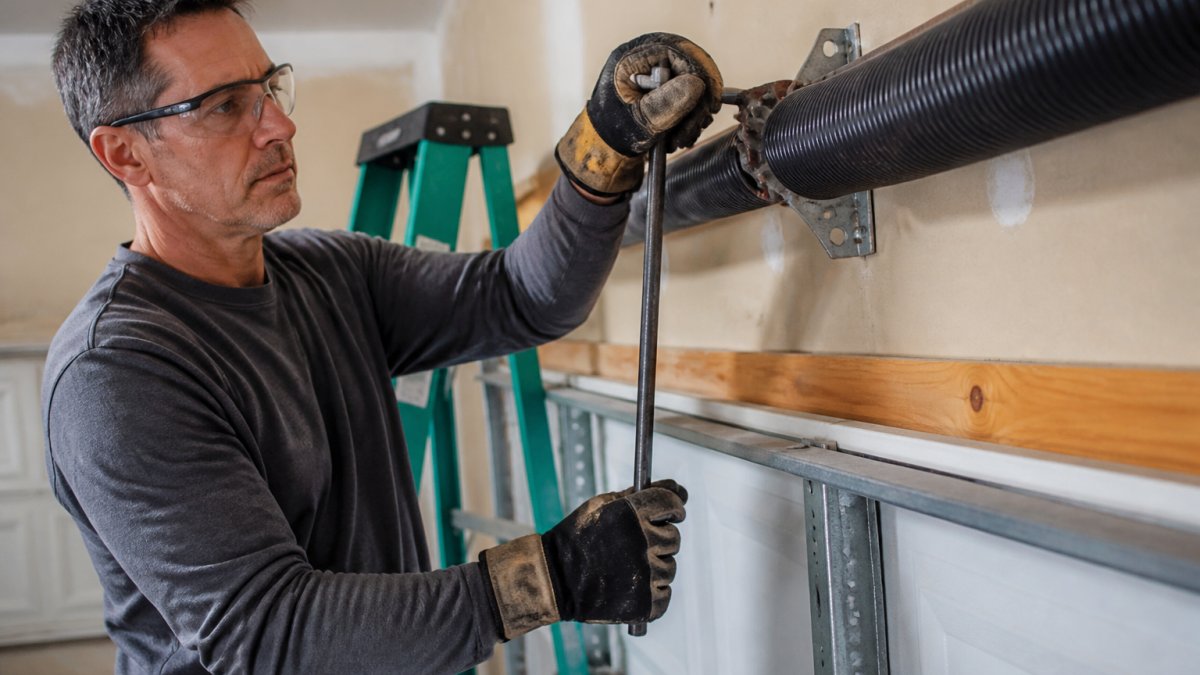
The most common injury happens during winding, when a bar slips out of the cone under load. Keep your face clear of the bar’s path, stand to the side rather than directly under the spring, and never use a bar that does not fully seat in the cone.
Post-installation verification checklist
Before you reconnect the opener, run this safe, non-invasive check.
- Door moves smoothly by hand through the full travel, with no binding or scraping.
- Door holds at the halfway point when released, balance is correct.
- Cables sit squarely in their drums and pulleys, with no crossing or slack.
If any item fails, stop and address it before regular use. Do not compensate for a balance problem by adjusting the opener travel, that masks the symptom and leaves the spring or cable fault in place.
Safety cables contain a broken extension spring; they do not prevent the break. The winding step is where injuries happen, so treat every bar insertion as a loaded operation. And verify balance and safety reverse before the door goes back into daily service.
Here is the installation procedure in the order the article lays it out.
| Step | What to do |
|---|---|
| 1 | Disconnect the opener and confirm manual operation |
| 2 | Clamp locking pliers on the track below the bottom roller |
| 3 | Identify torsion or extension and record spring measurements |
| 4 | Release tension slowly, turn by turn with winding bars |
| 5 | Replace the spring and rewind to the counted turns |
| 6 | Route cables, drums, and pulleys exactly as before |
| 7 | Test balance: door should hold at halfway |
When to Call a Garage Door Spring Repair Professional
Call a garage door spring repair professional when the spring is torsion, when the door is heavy or older, or when you have any doubt about the spring size.
A forum commenter once argued that spring replacement is safe if you follow a video and understand spring tension. That is an anecdote, not a safety finding.
Performance Building Products, Inc. sells, installs, and services garage doors, automatic openers, and fireplaces for homeowners and contractors. For current prices or a quote, visit the company website.
Frequently Asked Questions
Is it safe to install garage door springs yourself?
For most homeowners, no. Torsion and extension springs store enough energy to cause severe injury or death if released incorrectly. A case series in PMC documented seven patients with open-globe eye injuries from high-velocity garage door springs, all while attempting spring work. Only attempt installation if you have professional training, the correct winding bars, and a clear understanding of stored energy. Otherwise, hire a licensed technician.
Do extension garage door springs need safety cables?
Yes. Extension springs should always have safety cables running through them. If the spring breaks, the cable contains it and prevents it from flying across the garage. Without a containment cable, a snapped extension spring can cause serious injury or property damage. Check that cables are intact, properly secured at both ends, and free of fraying before operating the door.
What are the first signs of a broken garage door spring?
A loud bang from the garage, a door that feels extremely heavy when lifted manually, a visible gap in the spring, or a door that opens a few inches and stops are common signs. You may also see the opener straining or the door hanging unevenly. If you notice any of these, stop using the door and call a professional for inspection.
How much does a garage door spring repair professional charge?
Pricing depends on the spring type, door size, and your location. For an accurate quote, contact a licensed garage door company and ask for a written estimate that covers parts, labor, and warranty. Avoid hiring based on the lowest phone quote alone.
A broken spring is a safety problem, not just an inconvenience. Don’t gamble with stored energy. Get started with Performance Building Products, Inc. and let our team handle your spring replacement, opener service, and garage door repair safely and correctly.

Recent Comments