
Last Updated: November 22, 2026
Quick Summary
To learn how to fix a garage door that won’t close, start by clearing the door path and cleaning the safety sensor lenses, since a dirty or misaligned photo-eye is the most common cause. If the door only closes while you hold the wall button, align the sensors until both lights glow steady, then test with the remote.
- A stray rake, bike, or trash can in the door’s path will stop it every time.
- Holding the wall button overrides the safety sensors, which is why the door only moves while your finger stays on it.
- If the door reverses within a foot or two of the floor, the close travel limit is set too high.
- Pull the red emergency release cord to disconnect the door from the opener and lower it slowly by hand.
- After any adjustment, place a 2×4 flat on the floor in the door’s path and close the door; it should contact the board and reverse.
Table of Contents
- Garage Door Won’t Close: Start With These Safety Checks
- Garage Door Won’t Close Unless I Hold the Button Down
- Garage Door Won’t Close All the Way and Goes Back Up
- How to Close a Garage Door Manually
- How to Adjust a Garage Door to Close Completely
- Request Garage Door Service
- Frequently Asked Questions
Garage Door Won’t Close: Start With These Safety Checks
Learning how to fix a garage door that won’t close is usually a safety sensor problem, and you can often fix it yourself in a few minutes. This guide walks you through the checks that often resolve a how to fix a garage door that won’t close problem before you call anyone.
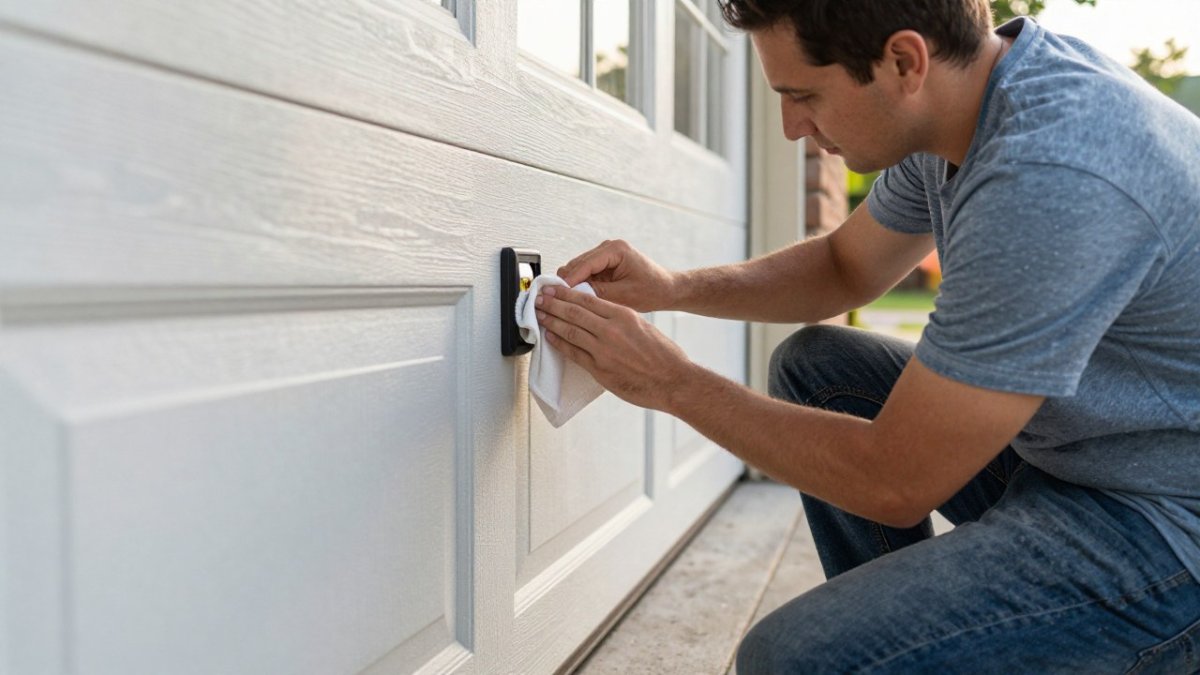
The garage door is often the largest moving object in your home, so small faults show up fast. Most “won’t close” calls trace back to one of a few simple causes.
Clear the Door Path and Test the Wall Control
Start by looking at the door itself. A stray rake, a bike, or a trash can in the door’s path will stop it every time.
- Remove anything under or near the door
- Check for cobwebs, leaves, or dirt on the sensor lenses
- Wipe the lenses with a soft, dry cloth
Next, try the wall control instead of the remote. Press and release it once. If the door closes and stays down, the problem is your remote, not the door.
A common mistake is blaming the opener when a dirty sensor lens is the real cause. Clean first, then test.
Garage Door Won’t Close Unless I Hold the Button Down
If your garage door won’t close unless I hold the button down, the safety sensors are almost certainly blocked, misaligned, or faulty.
The fix starts with the sensors. These small photo-eye units sit near the floor on each side of the door.
- Check that both sensor lights glow steady, not blinking
- Align each sensor so it faces the other directly
- Tighten any loose mounting brackets
If one light blinks, the beam is broken. For a deeper look at how these sensors protect your family, see our guide to garage door safety.
Garage Door Won’t Close All the Way and Goes Back Up
When a garage door won’t close all the way and goes back up, the opener is doing its job: it senses resistance or a broken safety beam and reverses to protect people and property. The trick is figuring out which input triggered the reverse. The behavior itself is the best clue.
Match the symptom to the likely cause
- Reverses immediately after starting down: the safety beam is blocked or misaligned, or the close-force setting is too low. Recheck the photo-eye lenses and alignment first, then the force setting.
- Reverses within a foot or two of the floor: the close travel limit is set too high, so the opener thinks it has hit the floor before it actually has. This is a limit adjustment, not a sensor problem.
- Stops short and reverses only in cold weather: a binding track, stiff rollers, or a swollen or frozen bottom seal is adding resistance. The door is harder to move, so the opener reads it as an obstruction.
Work through these checks in order
- Clear anything under the door and on the tracks.
- Confirm both sensor lights are steady, not blinking.
- Inspect the tracks for dents, debris, or bends, and the rollers and hinges for wear.
- Release the opener and test the door balance by hand. A well-balanced door should hold roughly where you leave it; one that drops or springs up needs spring or cable work.
- Adjust the close limit and force settings per your opener manual, in small increments, testing after each change.
Each opener model sets limits and force differently. Opener models set limits and force differently, and many newer openers use a control panel or app instead of screws. Check your model manual before turning anything, since guessing at adjustments can turn a small problem into a bigger one.
Watch out: never crank the force setting up to push a binding door shut. That masks a real mechanical problem, strains the opener, and defeats the safety reverse system.
When to stop and call a professional
If the door is off its tracks, if a cable is frayed or hanging, or if the door feels extremely heavy by hand, do not keep testing. Torsion springs and cables store enough tension to cause serious injury, and an off-track door can fall.
The behavior of the door is the best clue to what is triggering the reverse, so match the symptom to the likely cause.
| Symptom | Likely cause |
|---|---|
| Reverses immediately after starting down | Safety beam blocked or misaligned, or close-force setting too low |
| Reverses within a foot or two of the floor | Close travel limit set too high |
| Stops short and reverses only in cold weather | Binding track, stiff rollers, or swollen or frozen bottom seal |
| Reverses only in direct sunlight | Low sun blinding one photo-eye |
| Reverses at a random point | Loose sensor bracket, frayed sensor wire, or failing logic board |
How to Close a Garage Door Manually
You can close a garage door by hand during a power outage using the emergency release cord. Pull the red cord hanging from the trolley to disconnect the door from the opener, then lower the door slowly by hand.
Follow these steps:
- Pull the emergency release cord straight down
- Lift the door slightly to free the trolley
- Lower the door slowly and evenly with both hands
- Never let the door drop, since it is heavy and can cause injury
If the door feels extremely heavy or binds on one side, stop. A broken spring or cable is a serious hazard. Our article on how to manually open a garage door covers the full process safely.
How to Adjust a Garage Door to Close Completely
To adjust a garage door to close completely, set the close limit so the door meets the floor without reversing, then fine-tune the force setting only as much as the door genuinely needs. Limit and force are two different controls, and confusing them is the most common adjustment mistake.
- Close limit controls how far the door travels down. If the door stops an inch above the floor or presses too hard, this is the setting to change.
- Force (or sensitivity) controls how much resistance the opener tolerates before it reverses. Raise it only after the door moves freely by hand.
Adjust in this order
- Release the opener and move the door by hand. It should travel smoothly with one hand and hold position when you let go. If it binds, grinds, or drops, fix the mechanical problem first; no limit or force setting will compensate for a bad roller, a bent track, or a weak spring.
- Locate the limit and force controls. On many older openers these are labeled screws on the back or side of the motor housing; on newer models they are set through a wall panel, a remote, or a manufacturer app. Check your model manual for the exact procedure.
- Move the close limit in small increments, a quarter turn or one step at a time, and run a full close cycle after each change.
- Stop when the door meets the floor and the bottom seal compresses lightly without the door reversing.
- Adjust force last, and only enough to complete the cycle reliably. If you find yourself raising force repeatedly, stop; the door has a mechanical problem.
Watch out: never crank the force setting high to force a binding door shut. That masks a real problem, strains the opener, and can defeat the safety reverse system, which is the feature that protects anyone standing under the door.
Verify the repair before you call it done
After any adjustment, run the safety reverse test. Place a 2×4 flat on the floor in the door’s path and close the door; it should contact the board and reverse. Then test the photo-eye by passing an object through the beam while the door is closing. Finally, cycle the door fully open and closed two or three times and watch for smooth travel, even speed, and a clean seal at the floor. Our team can help with residential garage door services.
Request Garage Door Service
Some repairs are not safe to do yourself. Broken springs, snapped cables, and off-track doors store serious tension and can cause injury. If your checks point to one of these, stop and call a pro.
At Performance Building Products, our team brings over 150 years of combined industry experience to our work. If you have an urgent problem, our guide on emergency garage door repair services explains what to do first. When you’re ready, request a service appointment and we’ll get your door closing again.
A garage door that won’t close is frustrating, but most causes are simple to check. Start with the sensors and the door path, then work through the opener settings.
Frequently Asked Questions
How do I fix a garage door that won’t close?
Start by removing anything blocking the door path and wiping the photo-eye sensor lenses with a soft cloth. Check that both sensor indicator lights are solid, then inspect the tracks for debris or bent sections. If the door still won’t close, test the wall control and remote. When the door reverses or stops short, the issue is often sensor alignment, travel limits, or force settings. Repairs involving springs, cables, or the opener’s internal adjustments are best left to a professional.
Why won’t my garage door close when the power is out?
Most garage door openers need electricity to run the motor and safety sensors. During an outage, pull the emergency release cord to disconnect the door from the opener, then lift the door manually. If the door is too heavy to lift, stop and call a professional, because a spring may be broken. For how to close a garage door manually, always lower it slowly and keep hands clear of the hinges and tracks.
Why does my garage door go back up after closing?
A door that reverses after touching the floor usually has a travel limit set too low or a force setting that is too sensitive. It can also be caused by something as small as a pebble or a spider web crossing the sensor beam. Clean the sensor lenses, clear the tracks, and check that the close limit lets the door meet the floor without pressing hard. If adjustments don’t hold, an opener technician can reset the limits safely.
Can I adjust my garage door to close completely on my own?
You can safely clean the sensors, clear obstructions, and check the tracks. Adjusting travel limits or force settings is a step beyond basic troubleshooting, and the exact procedure varies by opener model, so check your owner’s manual first. Never adjust springs, cables, or the counterbalance system yourself, because those parts are under high tension and can cause serious injury. A professional can fine-tune how to adjust a garage door to close completely in one visit.

Recent Comments