
Last Updated: November 24, 2026
Quick Summary
To get electric fireplace size right for a living room, measure room square footage, wall width, and TV width when a TV shares the wall. A 1,500-watt unit produces roughly 5,118 BTU per hour and covers about 250 square feet under standard 8-foot-ceiling conditions, so treat that figure as a starting point, not a promise.
- Measure the insert opening’s width, height, and depth at the narrowest point, since the smallest dimension decides the fit.
- A 750-watt low setting covers roughly half the area of a 1,500-watt unit.
- A 75-inch TV is about 65 inches wide, so a fireplace in the 60-to-80-inch range reads as balanced beneath it.
- Leave at least 12 inches between the bottom of the TV and the top of the fireplace, and check the manufacturer’s heat clearance.
- Wall-mounted units need a nearby 120V outlet, so check outlet location before committing to a width.
Table of Contents
- Start With Three Measurements, Not One
- How to Measure for an Electric Fireplace Insert
- Electric Fireplace Dimensions for Wall Installation
- What 1,500-Watt Electric Fireplace Square-Foot Coverage Really Means
- Electric Fireplace Size for a 75-Inch TV and the Wall Around It
- Planning Your Living Room Installation
- Frequently Asked Questions
Start With Three Measurements, Not One
Most homeowners size an electric fireplace by eyeballing the wall or measuring the room once. That approach usually produces a unit that looks off or heats poorly. To get electric fireplace size right for a living room, you need three numbers: room square footage, wall width, and, when a TV shares the wall, TV width.
This guide walks through each measurement, the heating math behind wattage ratings, and the clearances that decide whether a unit actually fits.
Room Square Footage and Ceiling Height
Multiply length by width to get square footage. A 16-foot by 20-foot living room is 320 square feet. Ceiling height matters too: an 8-foot ceiling is standard, but vaulted rooms hold more air and need more heat output to feel warm.
Wall Width and Available Space
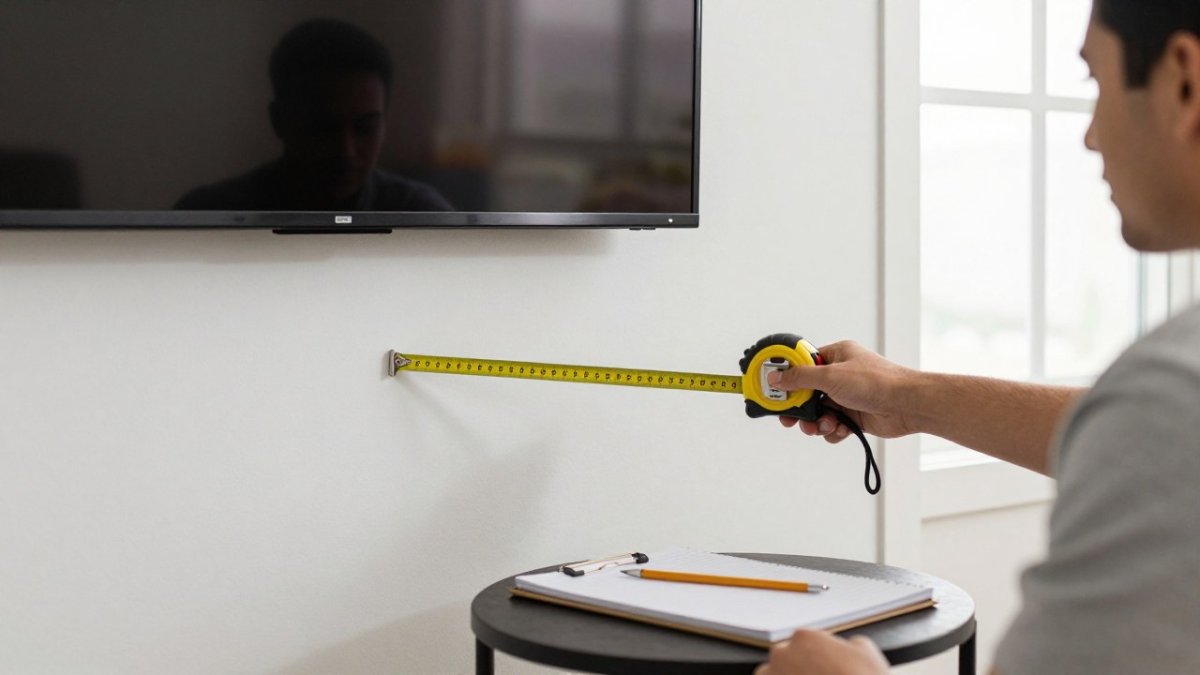
Measure the full width of the wall, then subtract anything already there: windows, doors, outlets, and furniture you plan to keep. That leftover figure is your true available space, and it caps how wide a fireplace can be.
How to Measure for an Electric Fireplace Insert
To measure for an electric fireplace insert, record the opening’s width, height, and depth at the narrowest point. Inserts drop into an existing firebox, so the smallest dimension decides the fit, not the average.
- Width: measure across the opening at the top, middle, and bottom
- Height: measure from the hearth to the top of the opening
- Depth: measure from the front face to the back wall
Write down the smallest number from each set. For a deeper look at matching a fireplace to a living room, see our guide on how to choose the perfect gas fireplace for your living room.
Electric Fireplace Dimensions for Wall Installation
Wall-mounted and recessed units are sized mainly by width, and the market spans a wide range. Lowe’s buying guide describes options from compact corner models to units 50 inches and wider, while Wayfair’s dimension guide gives a general range of 35 inches to more than 75 inches.
For a recessed fireplace, add rough-opening dimensions and framing depth to your list. If you want to see how linear styles sit on a modern wall, browse contemporary fireplaces or compare traditional fireplace designs for a classic layout.
| Installation Type | Key Measurement | Watch For |
|---|---|---|
| Wall-mounted | Wall width, outlet location | Cord reach and stud placement |
| Recessed | Rough opening, framing depth | Clearance to framing |
| Insert | Opening width, height, depth | Smallest dimension wins |
| Freestanding | Floor space, corner angle | Traffic flow around unit |
What 1,500-Watt Electric Fireplace Square-Foot Coverage Really Means
A 1,500-watt electric fireplace produces roughly 5,118 BTU per hour, and many units also offer a 750-watt low setting, according to Budget Heating’s 2026 buying guide. The common sizing rule of about 20 BTU per square foot assumes an 8-foot ceiling and average insulation, which puts a 1,500-watt unit at roughly 250 square feet of conditioned space. That number is a starting point, not a promise.
Why the Square-Footage Number Is a Ceiling, Not a Target
Electric fireplaces are generally supplemental heaters. They warm the zone in front of the unit and take the chill off a room, but they do not replace a central furnace or heat pump. NYC Fireplace Shop’s buying guide notes a typical 1,500-watt unit suits a bedroom, office, or small living room. A 2026 buyer’s guide from Walker Edison cites 400 to 1,000 square feet, but that range does not specify heater output or conditions, so treat it as a loose guide rather than a sizing formula.
The Four Variables That Move the Real Coverage Number
- Ceiling height. A vaulted or two-story living room holds far more air than the square footage suggests. A 320-square-foot room with a 14-foot ceiling has roughly 75% more air volume than the same room at 8 feet, so the effective coverage of a 1,500-watt unit shrinks accordingly.
- Insulation and window area. A wall of single-pane windows or an uninsulated bonus room loses heat faster than an interior living room, and the fireplace will feel weak even when the math says it fits.
- Open-plan layout. In an open kitchen-living-dining space, heat migrates toward the largest connected volume. A unit sized for the living-room footprint alone will underperform because it is effectively heating the whole open plan.
How to Translate Wattage Into a Practical Decision
Use the 20-BTU rule to estimate the room’s rough heating load, then compare it to the unit’s rated output. A 1,500-watt unit at 5,118 BTU covers about 250 square feet under standard conditions; a 750-watt low setting covers roughly half that.
Watch out: manufacturers rate heat output at the heater, not at the room, so a unit that meets the BTU math can still feel underwhelming in a drafty or open-plan living room. For a side-by-side breakdown of heat sources, read electric fireplace vs gas fireplace.
Electric Fireplace Size for a 75-Inch TV and the Wall Around It
A 75-inch TV is about 65 inches wide, so a fireplace in the 60-to-80-inch range reads as a balanced pair beneath it. The goal is visual weight: a fireplace noticeably narrower than the TV looks undersized, while one much wider turns the TV into an afterthought. Most designers land within about 10 inches of the TV width on either side.
Worked Layout Math for a 75-Inch TV Wall
Start with the TV width (about 65 inches) and the fireplace width you are considering, then check the total against the wall.
- Wall 96 inches wide (8 feet): a 60-inch fireplace leaves 18 inches on each side. A 72-inch unit leaves 12 inches per side, which is tight but workable if the wall is otherwise clear.
- Wall 120 inches wide (10 feet): a 72-inch fireplace leaves 24 inches per side, enough for sconces or a slim built-in. An 80-inch unit leaves 20 inches per side.
- Wall 144 inches wide (12 feet): an 80-inch fireplace leaves 32 inches per side, which supports a full mantel and flanking shelving.
Center the TV and fireplace on the same vertical line. If the wall has a window or door on one side, shift the pair so the fireplace stays centered on the usable wall, not the full wall.
Vertical Spacing, Mantel Depth, and Heat Clearance
Leave at least 12 inches between the bottom of the TV and the top of the fireplace, and check the manufacturer’s clearance for heat, some linear units specify more. A mantel shelf should be shallow enough that it does not block the flame display from seating; a shallow depth keeps the flame visible from seating.
Watch out: a mantel mounted too low over a linear fireplace can trap heat against the TV. Confirm both clearances before you drill.
Viewing Distance and Flame Proportions
Seating distance changes how large the flame reads. From 8 to 10 feet away, a 60-inch linear fireplace fills the focal wall comfortably; from 12 feet or more, a 72-to-80-inch unit keeps the flame from looking like a strip. Sit where you will actually watch from and judge the proportion before ordering.
Coordinating Sofa, Rug, and Surrounding Furniture
The fireplace should anchor the seating group, not float above it. Center the sofa on the fireplace, and keep the rug wide enough that the front sofa legs sit on it. If the sofa faces the TV wall, the fireplace width should roughly match the TV width so the two elements frame the seating zone. For style context, browse contemporary fireplaces or compare traditional fireplace designs before locking the width.
Planning Your Living Room Installation
Match the fireplace to the room first, then confirm framing, electrical, and clearances before ordering. A unit that fits the wall but lacks an outlet nearby means added electrical work.
When sizing is settled, browse premium fireplaces and professional installation in Southwest Washington and Oregon to see products and schedule installation. Performance Building Products has served homeowners and contractors since 1994, honors manufacturers’ warranties, and provides labor warranties on installations.
Sizing an electric fireplace comes down to three measurements and one honest look at heat output. If you would rather have it measured and installed correctly the first time, Performance Building Products offers professional installation with labor warranties, manufacturer warranty support, and a safety-first crew. Get started with Performance Building Products and get a fireplace that fits your wall and your room.
Frequently Asked Questions
How many square feet will a 1,500-watt electric fireplace heat?
A 1,500-watt heater produces roughly 5,118 BTU per hour, which works out to about 5,000 BTU in most specs. Using the common rule of 20 BTU per square foot with an 8-foot ceiling, that supports roughly 250 square feet of supplemental heat. For a large living room, plan on the fireplace as supplemental heat, not the primary heater.
How do I measure my wall before choosing an electric fireplace size?
Measure the full width of the wall, then subtract at least 6 inches on each side for breathing room and trim. Measure the height from floor to ceiling and note any TV, mantel, or window that shares the wall. For a recessed unit, measure the wall opening’s width, height, and depth and compare them to the framing requirements in the spec sheet. Write all three numbers down before you shop so you can rule out models that will not fit.
What size electric fireplace works under a 75-inch TV?
A 75-inch TV is about 65 to 66 inches wide. A fireplace roughly the same width or slightly narrower, in the 60 to 66 inch range, keeps the two elements visually balanced on a feature wall. Leave at least 6 to 12 inches of clearance between the top of the fireplace and the bottom of the TV, and check the fireplace spec sheet for its minimum clearance to electronics. A fireplace much wider than the TV will make the screen look undersized.
Should I choose a wall-mounted, recessed, or insert electric fireplace?
Wall-mounted units hang on the surface and need only an outlet nearby, which suits rentals and quick upgrades. Recessed models sit inside the wall and need framing, so they deliver the cleanest built-in look. Inserts drop into an existing masonry or factory-built firebox and reuse the opening. Freestanding and linear styles cover corner spaces and wide feature walls. Match the type to your wall construction, your electrical setup, and how much installation work you want to take on.

Recent Comments